
Dear Sheep
Baa, Baa, Where are you going?

Dear Sheep,
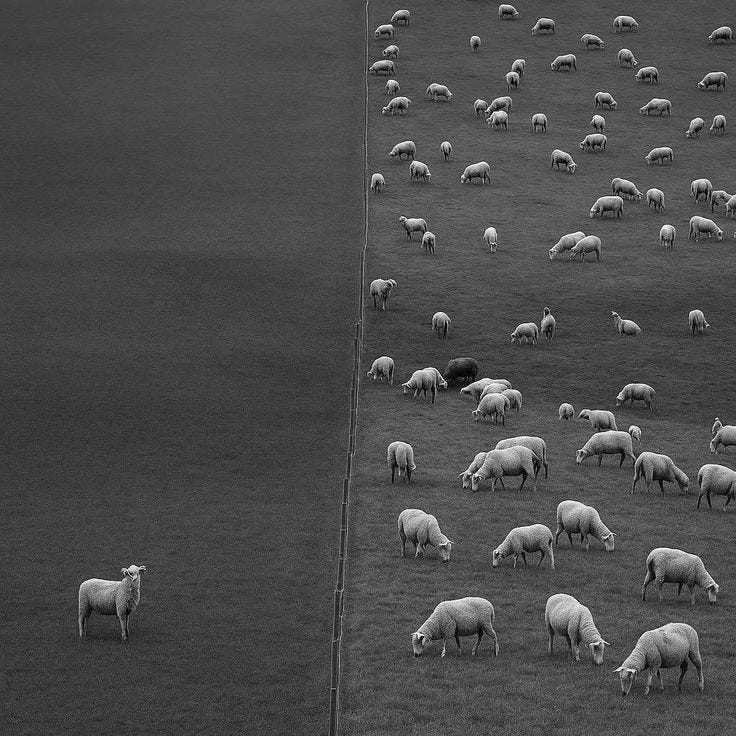
We often read the parable of the lost sheep and immediately focus on the Shepherd—which is right (A+). The parable was not told to emphasize the folly of the sheep, but to reveal the love of the Shepherd.
But a wandering thought brought me to this question:
Why were we called sheep in the first place?
Why did Jesus liken us to sheep?
We are described as sheep because that image reflects our relationship with God as our Shepherd. And when we examine the nature of sheep, we realize—we are indeed sheep. Jesus was intentional with this parable. It was not just a random story; it beautifully reveals both our relationship with God and the condition of man.
Sheep are dependent
Sheep cannot survive long on their own. They need guidance for food, water, and safety. In the same way, humans were created to live in dependence on God—not in isolation or self-sufficiency.
This takes us back to Genesis, where life began.
When God spoke the world into existence, everything was created with a purpose rooted in dependence. The seas were formed, and the fish came forth—but they could not survive outside the water. The birds were made for the sky, and the plants for the ground. Everything remained connected to its source.
But when God created man, He looked to Himself and said, “Let Us make man in Our image, after Our likeness.”
Not let there be man.
We came from intimacy. From God Himself.
Designed for dependence. Designed for relationship.In that moment, humanity came forth uniquely—bearing God’s image and designed for direct, ongoing relationship with Him.
This is what we were created for. Like a river flowing from its source, we were made to draw life, purpose, and meaning from God.
And so, when the fall happened, it was not just a small misstep of eating the wrong fruit. Adam’s choice in the garden was a conscious rejection of God’s design. God had already warned them: “In the day you eat of it, you shall surely die.” This was not merely a threat—it was the natural consequence of a choice.
Yet God placed that choice in the garden because love cannot exist without the possibility of choice. He desired that man would love Him freely—not as programmed beings, but as individuals with genuine free will.
You may wonder, “I wasn’t there—what does this have to do with me?”
Adam was not just a man. He was a representative.
If the president of your country signs a treaty of war, every citizen is at war — even the baby born the next morning. Not because they voted for it. Because the head represents the body.
When Adam fell, we fell in him.
Not necessarily as punishment. As consequence
This break from God, who is life, means we stepped into death and separation. We became lost, running from Him in rebellion.
We could not find our way back to God on our own.
Somewhere along the way, we forgot our home.
Oh little sheep, we forgot what home was meant to be. We forgot who home truly is.
Christ is our true home—the place where we fully belong, where we are known and loved.
But in our wandering, we tried to build homes in all the wrong places. We sought belonging in substances, in status, in success—things never meant to carry the weight of our identity.
Then, as we began to settle in the darkness, mistaking fear for comfort and emptiness for delight—
The Shepherd came looking.
With love,❤️
Folashade
They were never meant to carry the weight of our identity ❤️❤️❤️! Absolutely Beautiful 👏👏👏
Yurrrr
Thank youuuu❤️